
OliveTin (Web-UI für Shell-Cmds)
OliveTin
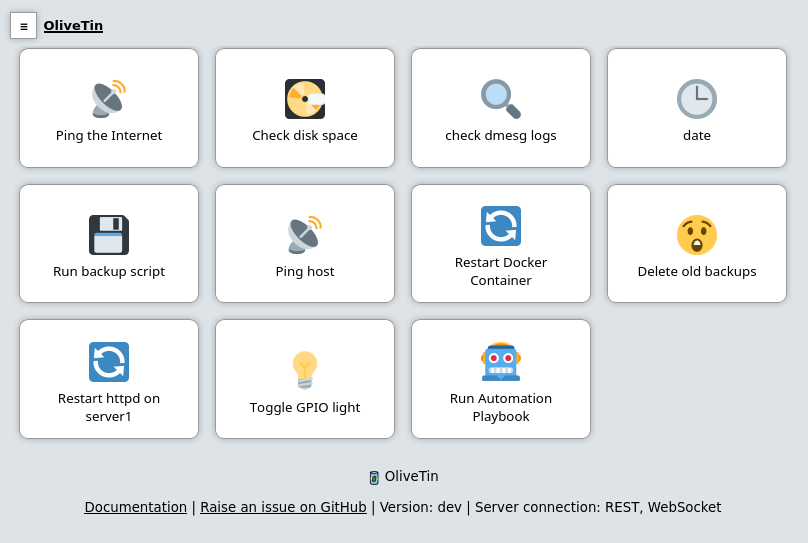
https://github.com/OliveTin/OliveTin
Eikes docker-compose.yml (mit Möglichkeit für docker exec cmds)
version: "3.8"
services:
  olivetin:
    container_name: olivetin
    image: jamesread/olivetin:2024.11.18
    user: root # wichtig für 'docker exec... Befehle in anderen Containern'
    volumes:
      - cfg:/config
      - /var/run/docker.sock:/var/run/docker.sock # wichtig für 'docker exec... Befehle in anderen Containern'
    ports:
      - "1337:1337"
    restart: unless-stopped

volumes:
  cfg:
Eikes config.yaml für Jitsi
# There is a built-in micro proxy that will host the webui and REST API all on
# one port (this is called the "Single HTTP Frontend") and means you just need
# one open port in the container/firewalls/etc.
#
# Listen on all addresses available, port 1337
listenAddressSingleHTTPFrontend: 0.0.0.0:1337

# Choose from INFO (default), WARN and DEBUG
logLevel: "INFO"

# Checking for updates https://docs.olivetin.app/update-checks.html
checkForUpdates: false

showFooter: false

# Actions are commands that are executed by OliveTin, and normally show up as
# buttons on the WebUI.
#
# Docs: https://docs.olivetin.app/create-your-first-action.html
actions:
  # This uses `popupOnStart: execution-dialog-stdout-only` to simply show just
  # the command output.
  - title: Checke Speicherplatz
    icon: disk
    shell: df -h /media
    popupOnStart: execution-dialog-stdout-only


  - title: Jitsi Moderatoren auflisten
    icon: logs
    shell: docker exec jitsi-prosody-1 sh -c "find /config/data/meet%2ejitsi/accounts -type f -exec basename {} .dat \; | sed -e 's/%2e/./g' -e 's/%2d/-/g' -e 's/%5f/_/g'"
    popupOnStart: execution-dialog-stdout-only


  - title: Jitsi Moderator anlegen
    #shell: echo {{ beuntzername }} meet.jitsi {{ passwort }}
    shell: docker exec jitsi-prosody-1 sh -c "prosodyctl --config /config/prosody.cfg.lua register {{ beuntzername }} meet.jitsi {{ passwort }}"
    icon: ping
    timeout: 100
    popupOnStart: execution-dialog-stdout-only
    arguments:
      - name: beuntzername
        title: Benutzername
        type: ascii_identifier
        default: m.oderator
        description: Verwende nur "-", "_" und "." als Sonderzeichen, keine Umlaute
      - name: passwort
        title: Passwort
        type: ascii_identifier
        default: Passwort123
        description: keine Leerzeichen, PW abspeichern!


  - title: Jitsi Moderator löschen
    #shell: echo {{ beuntzername }} meet.jitsi {{ passwort }}
    shell: docker exec jitsi-prosody-1 sh -c "prosodyctl --config /config/prosody.cfg.lua unregister {{ beuntzername }} meet.jitsi"
    icon: ashtonished
    timeout: 100
    popupOnStart: execution-dialog-stdout-only
    arguments:
      - name: beuntzername
        title: Benutzername
        type: ascii_identifier
        default: m.oderator
        description: Der Name des Moderators zb m.oderator
Original config.yaml mit Beispielen
# There is a built-in micro proxy that will host the webui and REST API all on
# one port (this is called the "Single HTTP Frontend") and means you just need
# one open port in the container/firewalls/etc.
#
# Listen on all addresses available, port 1337
listenAddressSingleHTTPFrontend: 0.0.0.0:1337
# Choose from INFO (default), WARN and DEBUG
logLevel: "INFO"
# Checking for updates https://docs.olivetin.app/update-checks.html
checkForUpdates: false
# Actions are commands that are executed by OliveTin, and normally show up as
# buttons on the WebUI.
#
# Docs: https://docs.olivetin.app/create-your-first-action.html
actions:
# This is the most simple action, it just runs the command and flashes the
# button to indicate status.
#
# If you are running OliveTin in a container remember to pass through the
# docker socket! https://docs.olivetin.app/action-container-control.html
- title: Ping the Internet
shell: ping -c 3 1.1.1.1
icon: ping
popupOnStart: execution-dialog-stdout-only
# This uses `popupOnStart: execution-dialog-stdout-only` to simply show just
# the command output.
- title: Check disk space
icon: disk
shell: df -h /media
popupOnStart: execution-dialog-stdout-only
# This uses `popupOnStart: execution-dialog` to show a dialog with more
# information about the command that was run.
- title: check dmesg logs
shell: dmesg | tail
icon: logs
popupOnStart: execution-dialog
# This uses `popupOnStart: execution-button` to display a mini button that
# links to the logs.
- title: date
shell: date
timeout: 6
icon: clock
popupOnStart: execution-button
# You are not limited to operating system commands, and of course you can run
# your own scripts. Here `maxConcurrent` stops the script running multiple
# times in parallel. There is also a timeout that will kill the command if it
# runs for too long.
- title: Run backup script
shell: /opt/backupScript.sh
shellAfterCompleted: "apprise -t 'Notification: Backup script completed' -b 'The backup script completed with code {{ exitCode}}. The log is: \n {{ output }} '"
maxConcurrent: 1
timeout: 10
icon: backup
popupOnStart: execution-dialog
# When you want to prompt users for input, that is when you should use
# `arguments` - this presents a popup dialog and asks for argument values.
#
# Docs: https://docs.olivetin.app/action-ping.html
- title: Ping host
shell: ping {{ host }} -c {{ count }}
icon: ping
timeout: 100
popupOnStart: execution-dialog-stdout-only
arguments:
- name: host
title: Host
type: ascii_identifier
default: example.com
description: The host that you want to ping
- name: count
title: Count
type: int
default: 3
description: How many times to do you want to ping?
# OliveTin can control containers - docker is just a command line app.
#
# However, if you are running in a container you will need to do some setup,
# see the docs below.
#
# Docs: https://docs.olivetin.app/action-container-control.html
- title: Restart Docker Container
icon: restart
shell: docker restart {{ container }}
arguments:
- name: container
title: Container name
choices:
- value: plex
- value: traefik
- value: grafana
# There is a special `confirmation` argument to help against accidental clicks
# on "dangerous" actions.
#
# Docs: https://docs.olivetin.app/confirmation.html
- title: Delete old backups
icon: ashtonished
shell: rm -rf /opt/oldBackups/
arguments:
- type: confirmation
title: Are you sure?!
# This is an action that runs a script included with OliveTin, that will
# download themes. You will still need to set theme "themeName" in your config.
#
# Docs: https://docs.olivetin.app/themes.html
- title: Get OliveTin Theme
shell: olivetin-get-theme {{ themeGitRepo }} {{ themeFolderName }}
icon: theme
arguments:
- name: themeGitRepo
title: Theme's Git Repository
description: Find new themes at https://olivetin.app/themes
type: url
- name: themeFolderName
title: Theme's Folder Name
type: ascii_identifier
# Sometimes you want to run actions on other servers - don't overcomplicate
# it, just use SSH! OliveTin includes a helper to make this easier, which is
# entirely optional. You can also setup SSH manually.
#
# Docs: https://docs.olivetin.app/action-ssh-easy.html
# Docs: https://docs.olivetin.app/action-ssh.html
- title: "Setup easy SSH"
icon: ssh
shell: olivetin-setup-easy-ssh
popupOnStart: execution-dialog
# Here's how to use SSH with the "easy" config, to restart a service on
# another server.
#
# Docs: https://docs.olivetin.app/action-ssh-easy.html
# Docs: https://docs.olivetin.app/action-service.html
- title: Restart httpd on server1
id: restart_httpd
icon: restart
timeout: 1
shell: ssh -F /config/ssh/easy.cg root@server1 'service httpd restart'
# Lots of people use OliveTin to build web interfaces for their electronics
# projects. It's best to install OliveTin as a native package (eg, .deb), and
# then you can use either a python script or the `gpio` command.
- title: Toggle GPIO light
shell: gpioset gpiochip1 9=1
icon: light
# There are several built-in shortcuts for the `icon` option, but you
# can also just specify any HTML, this includes any unicode character,
# or a <img = "..." /> link to a custom icon.
#
# Docs: https://docs.olivetin.app/icons.html
#
# Lots of people use OliveTin to easily execute ansible-playbooks. You
# probably want a much longer timeout as well (so that ansible completes).
#
# Docs: https://docs.olivetin.app/ansible-playbook.html
- title: "Run Automation Playbook"
icon: '🤖'
shell: ansible-playbook -i /etc/hosts /root/myRepo/myPlaybook.yaml
timeout: 120
# The following actions are "dummy" actions, used in a Dashboard. As long as
# you have these referenced in a dashboard, they will not show up in the
# `actions` view.
- title: Ping hypervisor1
shell: echo "hypervisor1 online"
- title: Ping hypervisor2
shell: echo "hypervisor2 online"
- title: "{{ server.name }} Wake on Lan"
shell: echo "Sending Wake on LAN to {{ server.hostname }}"
entity: server
- title: "{{ server.name }} Power Off"
shell: "echo 'Power Off Server: {{ server.hostname }}'"
entity: server
- title: Ping All Servers
shell: "echo 'Ping all servers'"
icon: ping
- title: Start {{ container.Names }}
icon: box
shell: docker start {{ container.Names }}
entity: container
trigger: Update container entity file
- title: Stop {{ container.Names }}
icon: box
shell: docker stop {{ container.Names }}
entity: container
trigger: Update container entity file
# Lastly, you can hide actions from the web UI, this is useful for creating
# background helpers that execute only on startup or a cron, for updating
# entity files.
# - title: Update container entity file
# shell: 'docker ps -a --format json > /etc/OliveTin/entities/containers.json'
# hidden: true
# execOnStartup: true
# execOnCron: '*/1 * * * *'
# An entity is something that exists - a "thing", like a VM, or a Container
# is an entity. OliveTin allows you to then dynamically generate actions based
# around these entities.
#
# This is really useful if you want to generate wake on lan or poweroff actions
# for `server` entities, for example.
#
# A very popular use case that entities were designed for was for `container`
# entities - in a similar way you could generate `start`, `stop`, and `restart`
# container actions.
#
# Entities are just loaded fome files on disk, OliveTin will also watch these
# files for updates while OliveTin is running, and update entities.
#
# Entities can have properties defined in those files, and those can be used
# in your configuration as variables. For example; `container.status`,
# or `vm.hostname`.
#
# Docs: http://docs.olivetin.app/entities.html
entities:
# YAML files are the default expected format, so you can use .yml or .yaml,
# or even .txt, as long as the file contains valid a valid yaml LIST, then it
# will load properly.
#
# Docs: https://docs.olivetin.app/entities.html
- file: entities/servers.yaml
name: server
- file: entities/containers.json
name: container
# Dashboards are a way of taking actions from the default "actions" view, and
# organizing them into groups - either into folders, or fieldsets.
#
# The only way to properly use entities, are to use them with a `fieldset` on
# a dashboard.
dashboards:
# Top level items are dashboards.
- title: My Servers
contents:
- title: All Servers
type: fieldset
contents:
# The contents of a dashboard will try to look for an action with a
# matching title IF the `contents: ` property is empty.
- title: Ping All Servers
# If you create an item with some "contents:", OliveTin will show that as
# directory.
- title: Hypervisors
contents:
- title: Ping hypervisor1
- title: Ping hypervisor2
# If you specify `type: fieldset` and some `contents`, it will show your
# actions grouped together without a folder.
- type: fieldset
entity: server
title: 'Server: {{ server.hostname }}'
contents:
# By default OliveTin will look for an action with a matching title
# and put it on the dashboard.
#
# Fieldsets also support `type: display`, which can display arbitary
# text. This is useful for displaying things like a container's state.
- type: display
title: |
Hostname: <strong>{{ server.name }}</strong>
IP Address: <strong>{{ server.ip }}</strong>
# These are the actions (defined above) that we want on the dashboard.
- title: '{{ server.name }} Wake on Lan'
- title: '{{ server.name }} Power Off'
# This is the second dashboard.
- title: My Containers
contents:
- title: 'Container {{ container.Names }} ({{ container.Image }})'
entity: container
type: fieldset
contents:
- type: display
title: |
{{ container.RunningFor }} <br /><br /><strong>{{ container.State }}</strong>
- title: 'Start {{ container.Names }}'
- title: 'Stop {{ container.Names }}'config.yaml Beispiel für Jitsi Meet Moderator anlegen
actions:
  - title: Jitsi Moderator anlegen
      #shell: echo {{ beuntzername }} meet.jitsi {{ passwort }}
      shell: docker exec jitsi-prosody-1 sh -c "prosodyctl --config /config/prosody.cfg.lua register {{ beuntzername }} meet.jitsi {{ passwort }}"
      icon: ping
      timeout: 100
      popupOnStart: execution-dialog-stdout-only
      arguments:
        - name: beuntzername
          title: Benutzername
          type: ascii_identifier
          default: m.oderator
          description: Der Name des Moderators zb m.oderator

        - name: passwort
          title: Passwort
          type: ascii_identifier
          default: Passwort123
          description: Das Passwort (keine Leerzeichen, PW abspeichern!)